
Wheeling Previous Resident Sources
Start with the source closest to the date being studied. Current parcel and deed records establish the backward title path. Directories, census schedules, maps, and newspapers then add the people and buildings that ownership records leave out.
| Source | Years It Covers | Where Held | What It Shows |
|---|---|---|---|
| Clerk Document Inquiry | 1993-present | Ohio County Clerk | Instrument parties, type, and deed reference |
| Vault deed books | 1777-1992 | Ohio County Clerk | Grantor, grantee, book/page, older images |
| Wheeling directories | 1839 onward; reverse sections about 1898+ | OCPL / HeritageQuest | Occupants and businesses by name or address |
| Federal census | Decennial through 1950 public | Census, NARA, library | Household structure and ward context |
| Sanborn maps | 1884-1952 runs | Library of Congress / OCPL | Building footprint, use, and block numbering |
| Newspapers | Intelligencer 1852+; News-Register runs vary | OCPL online and microfilm | Obituaries, notices, family and address clues |
The records overlap imperfectly. A directory can identify a past resident while the deed names a remote owner. Census records add household structure but use historic ward boundaries. Sanborn maps date buildings, not people. A strong conclusion uses at least two independent sources.
Build a dated worksheet with separate columns for owner, occupant, source, printed address, and source date. Keep uncertainty visible. If a directory skips a year, use the nearest volumes instead of assuming the same household remained. If a census lacks a modern street number, use the ward, nearby streets, and names recovered from directories. Previous residents become credible when records agree on identity, place, and time.
Freeze the Wheeling Parcel First
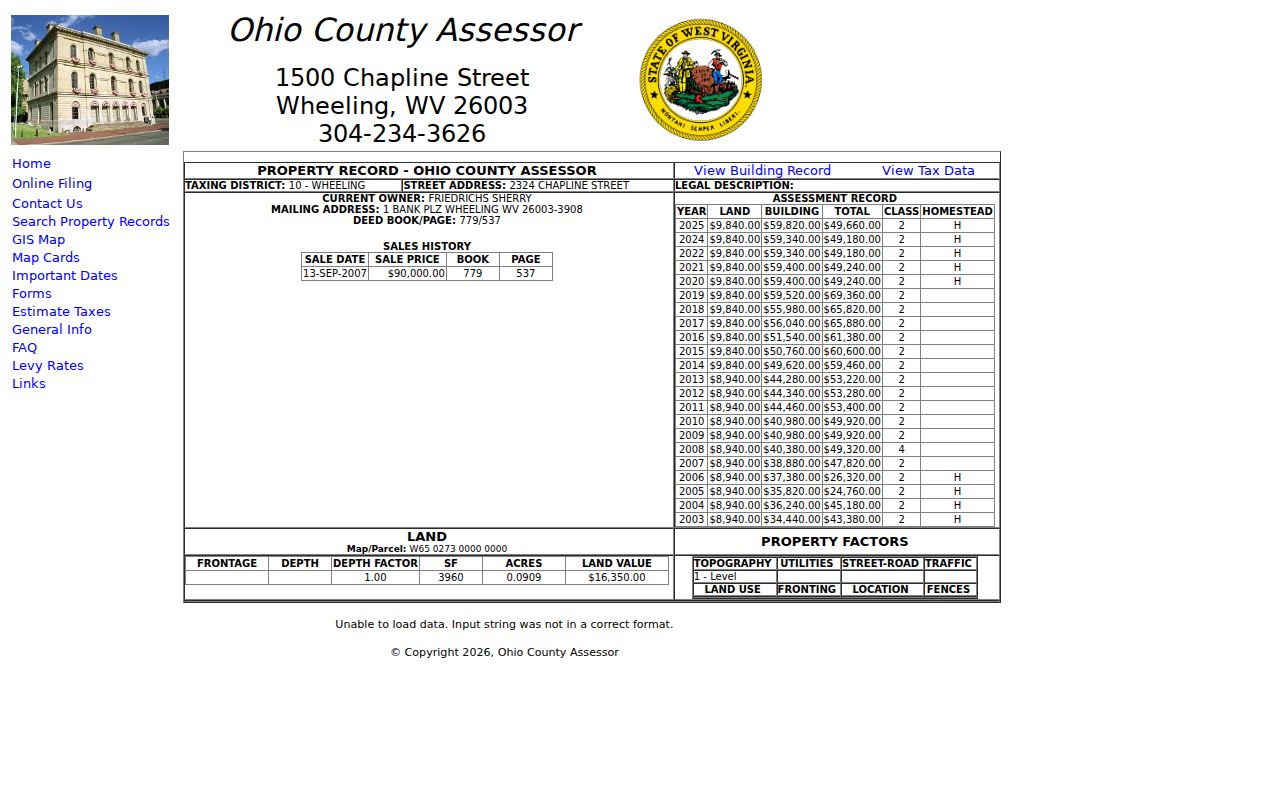
Open the Ohio County Assessor Property Search and record the exact situs, map and parcel, current owner, mailing address, legal description, and deed book/page. Save the legal description even when the street number seems clear. It survives changes in numbering better than an address alone.
The assessor card is a tax record. Its owner line is not an occupant list, and the separate mailing address may point to a bank, trust, company, or another person. The deed reference is the useful pivot. Confirm that it leads to the acquisition deed rather than a later instrument.
Trace Wheeling's Deed Chain Backward
The Ohio County Clerk search hub is not one database. Document Inquiry handles January 1, 1993 to the present. Older work moves into separate Vault index periods extending to 1777.
- Pull the current owner's acquisition deed using the assessor's book and page.
- Identify the seller, or grantor, and the buyer, or grantee.
- Search that seller as a grantee in an earlier date range to find the seller's purchase.
- Repeat the transfer sequence, checking trusts, estates, and every named party when needed.
- Before 1993, choose the correct Vault period, alphabetical book, page, and then the book-image route.
- Grantor / grantee
- The person or entity giving property, and the one receiving it.
- Chain of title
- The linked sequence of recorded transfers for one parcel.
- Legal description
- The lot, block, boundary, or survey language that identifies land apart from its street number.
Deeds of trust, releases, liens, and powers of attorney may sit beside deeds in the index. They can explain financing or a signer, but they do not all mark a change of owner. Images of new instruments may lag the index by about 28 business hours.
The Vault workflow takes more care. Select the date block and correct grantor or grantee alphabetic book, find the index page, then use Image Search with the cited book and book/page. Do not put the page in the suffix field. If a person appears under initials, a married name, or an estate, search each printed form. Copy charges follow the Clerk's page schedule, with a separate processor charge when that payment system is used.
Translate Wheeling's 1873 Numbers
Wheeling changed street names and address numbers on July 11, 1873. The change reached some streets whose names stayed the same, so a familiar name does not guarantee a familiar number. This is the central quirk in research on previous residents.
The OCPL historic-property guide points to a pre-and-post change handout and a map set. Keep the original address in the timeline, find its translated form, and confirm the result with a legal description or map parcel. Silently replacing the old number can attach the wrong household to a modern building.
Check the numbers on both sides of the target in the directory and map. Corner buildings, combined lots, split lots, and business addresses can shift the apparent sequence. A match is much stronger when the old map, directory neighbors, and deed description point to the same site. Store both old and new numbers in the timeline rather than treating one as a correction of the other.
Date Wheeling Buildings With Maps
Sanborn fire-insurance maps show footprints, construction context, use, and address blocks. The Library of Congress runs named in the research include 1884, 1890, 1902, 1921-22, later 1921-51 volumes, and 1952. OCPL holds selected Sanborn volumes by appointment plus city maps from 1853, 1871, 1901, 1913, and 1918.
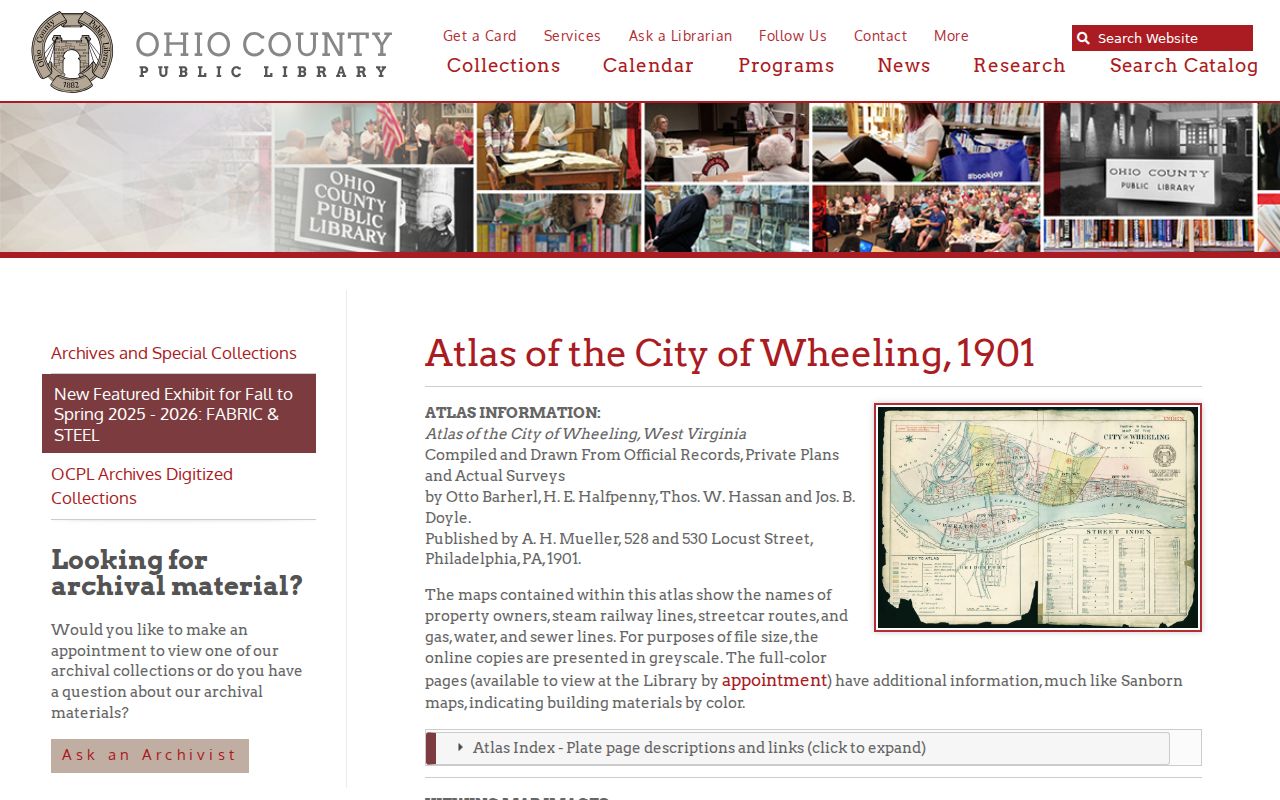
The 1901 Wheeling atlas adds property owners, rail and streetcar lines, and gas, water, and sewer context. Its online view is grayscale; color access requires an appointment. The unusual 1913 map titled “Great Number of Privy Vaults” can help date sanitation and built-form changes, but it is not a list of residents.
The digitized atlas presents the owner and infrastructure map collection.
Wheeling Room House History
The Ohio County Public Library's house-history service gathers the address tools that online county portals do not. The Wheeling Room contains city directories, cemetery indexes, yearbooks, family and church histories, microfilm, and vertical files. Materials do not circulate, the room is locked, and access is requested at the Reference Desk. Archives and map use may require an appointment.
No bags, purses, or backpacks are allowed inside; lockers are provided. Notebooks, laptops, tablets, and recording devices are permitted. That setup rewards a prepared visit: bring the parcel ID, every old address, a list of owners and occupants, and the known date range. The guide also identifies call number 917.5415025 for house research.
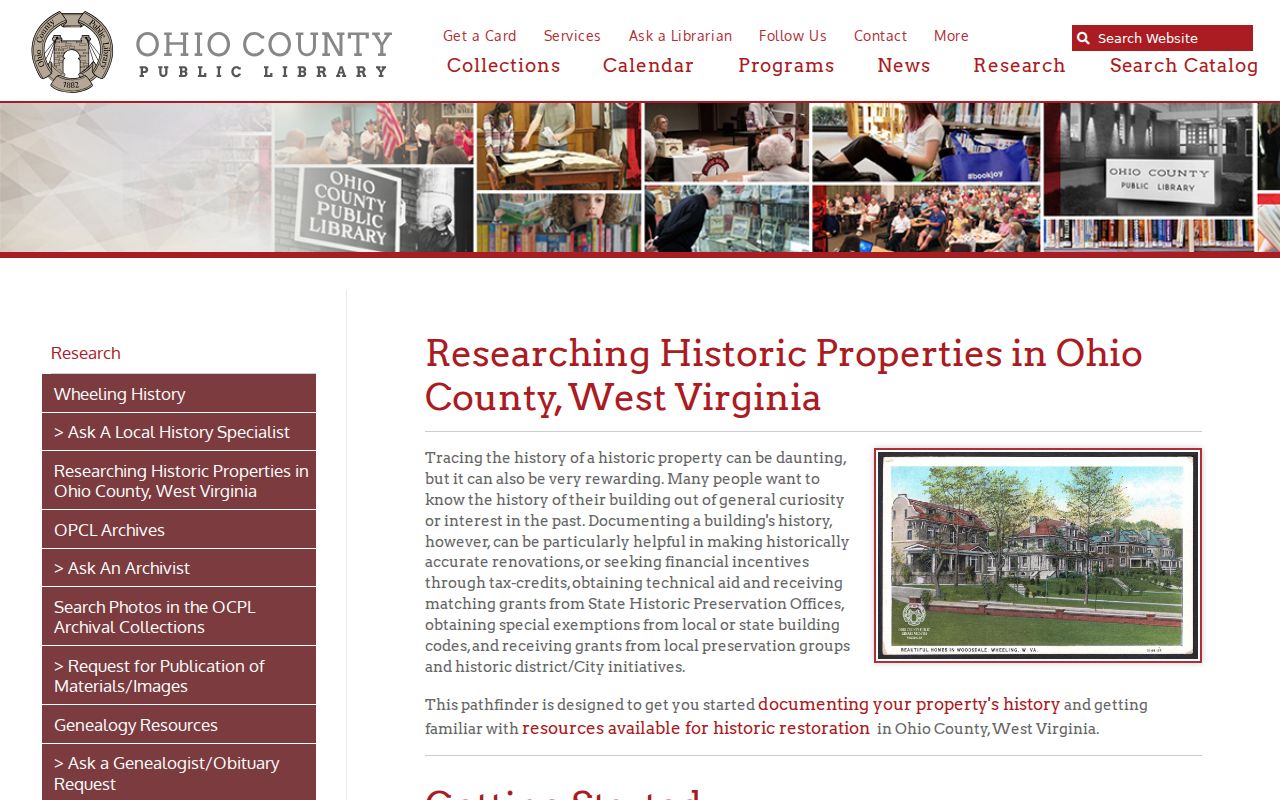
The library's illustrated historic-property guide links the core maps and search methods.
Wheeling Past Households in Context
Owners are only half of a house history. Most local directories from about 1898 include a reverse section arranged by street and number. A listed name is a directory occupant or business, not proof of title. The detailed publisher and shelf runs are covered with the Wheeling city directories.
- Search the reverse section for the address and nearby numbers.
- Record names, spouse or widow notes, trade, business, and every printed address exactly.
- Compare several neighboring directory years to spot arrivals, departures, or renumbering.
- Pair the entry with the nearest public federal census through 1950, allowing for old ward boundaries.
- Verify ownership in the deed chain and explain transitions with newspapers or probate.
OCPL newspapers can close the trail. The Intelligencer begins in 1852, while stated News-Register coverage differs among library pages and should be checked for the needed date. Microfilm is available when an online run falls short. An obituary may name a spouse, children, and last address; an Ohio County probate file may identify heirs and a later transfer.
Lawful use. Research previous residents for house history, genealogy, or estate work. Never use personal details to track, stalk, harass, or harm anyone.
When Wheeling Records Go Missing
A failed web search does not prove that a record never existed. The Clerk keeps older grantor and grantee books in separate Vault periods. OCPL has maps and newspapers, while the WVU Regional History Center finding aid identifies early deed books, land entries, marriage licenses, an 1888 Wheeling ward census, and personal-property books.
Ask the Clerk for the book and page, use the photocopy-request channel, or visit the counter when the image is absent. Building and Planning can receive a focused permit request, and archives should be called for map appointments. W.Va. Code §39-3-3 provides a route to reconstruct a lost record from certified copies. No verified courthouse disaster erased a Wheeling decade, so gaps should be investigated record by record.
Wheeling's court records also moved as civic buildings changed. The county court met in Wheeling by May 7, 1798, later used successive courthouses, and temporarily sat at the Greek Orthodox Hellenic Center during mid-twentieth-century demolition and construction. That history does not prove a records loss. It does explain why an old reference may lead to a successor office, archive, or microfilm guide rather than a modern online box.
For previous residents tied to an estate, ask the Ohio County Clerk's probate and fiduciary counter about wills, inventories, appraisements, settlements, and related filings. A probate file may identify heirs and explain a deed signed by an estate. Restricted portions and personal identifiers can remain unavailable, so request the specific public document rather than an undefined complete file.