
Wheeling Directory Runs by Publisher
The Ohio County Public Library shelf inventory is the clearest record of Wheeling city directory holdings. It begins with J. B. Bowen's early books, continues through Williams and Callin editions, and reaches the long Polk run. Most volumes are in the library's Wheeling Room. They do not circulate, and an edition should be confirmed before a visit because the Polk sequence depends on the volume actually available. These books are more than phone lists. Early volumes connect heads of families with trades and places, while later editions add strong address-first tools.
| Collection | Years | Where Held | Access |
|---|---|---|---|
| J. B. Bowen | 1839, 1843 | OCPL Wheeling Room | Noncirculating; 1839 catalog metadata online |
| Williams | 1856, 1864, 1867-68 | OCPL Wheeling Room | In-person city guide and people entries |
| Callin | Selected editions, 1877 through 1923-24 | OCPL Wheeling Room | In person; later books support address-first work |
| Polk's | 1924-present, by available volume | OCPL and HeritageQuest portions | In person; remote service requires an OCPL card |
The Callin shelf is not one unbroken annual run. Listed volumes include 1877, 1880, even-numbered editions through much of the 1890s, and paired-year books into the 1920s. A person missing from one available volume may appear in the next book. Record the edition date exactly and never treat a span such as 1911-12 as two separate annual observations.
Inside Wheeling's History Room
The Wheeling Room holds city directories beside cemetery indexes, yearbooks, family and church histories, local books, microfilm, and vertical files. It is locked and noncirculating. Visitors request entry at the Reference Desk, place bags and purses in supplied lockers, and may bring notebooks, laptops, tablets, and recording devices. A genealogist is generally available from 9 a.m. to 4 p.m. on weekdays.
The library is at 52 16th Street, 304-232-0244. Hours are Monday through Thursday, 9 a.m. to 9 p.m.; Friday, 10 a.m. to 5 p.m.; and Saturday, 9 a.m. to 5 p.m. Archives and map work may require an appointment. Bring names, date ranges, and both old and current street forms. That turns shelf work into a timeline.
The Wheeling Room overview shows its rules and local resources.
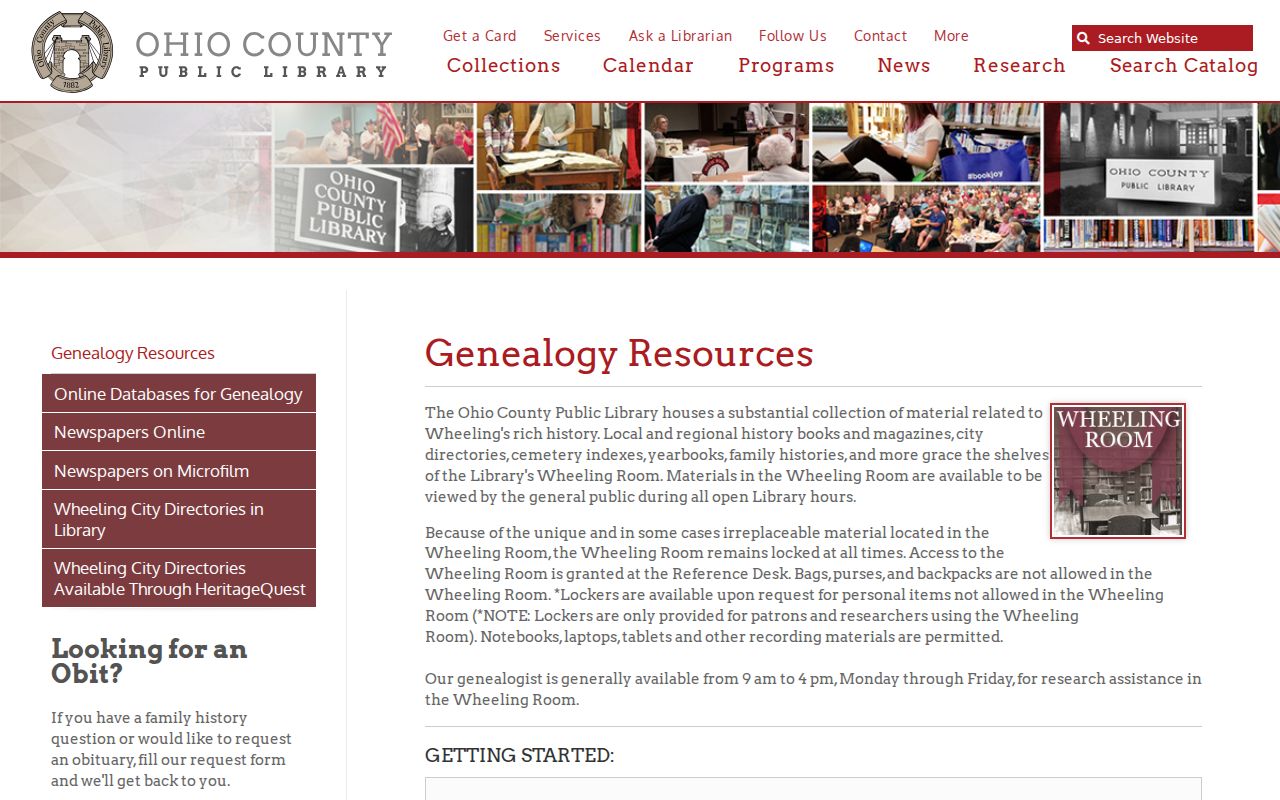
The captured page helps visitors check access details before asking staff for a directory or companion source.
Bowen's First Wheeling Directory
The earliest identified volume is The Wheeling Directory and Advertiser, published by J. B. Bowen in 1839 and printed by John M. M'Creary. Its catalog describes 90 pages with an alphabetical list of heads of families, trades, street or alley locations, house numbers, places of business, family residences, and merchant cards. It is a useful city snapshot, not a full household census.
Bowen issued an 1843 edition. Williams books appear in 1856, 1864, and 1867-68, then Callin carries the sequence into the next century. This timeline helps distinguish a shelf gap from a failed spelling search. It also shows why one method will not fit every era.
| 1839 | First identified Bowen directory |
|---|---|
| 1856 | Williams directory, city guide, and business mirror |
| 1877 | First Callin volume in the OCPL inventory |
| 1898 onward | Most books include a reverse street section |
| 1924 onward | Polk's run, by editions available |
The library's Wheeling city directory inventory records the publisher and edition sequence available on the physical shelf.
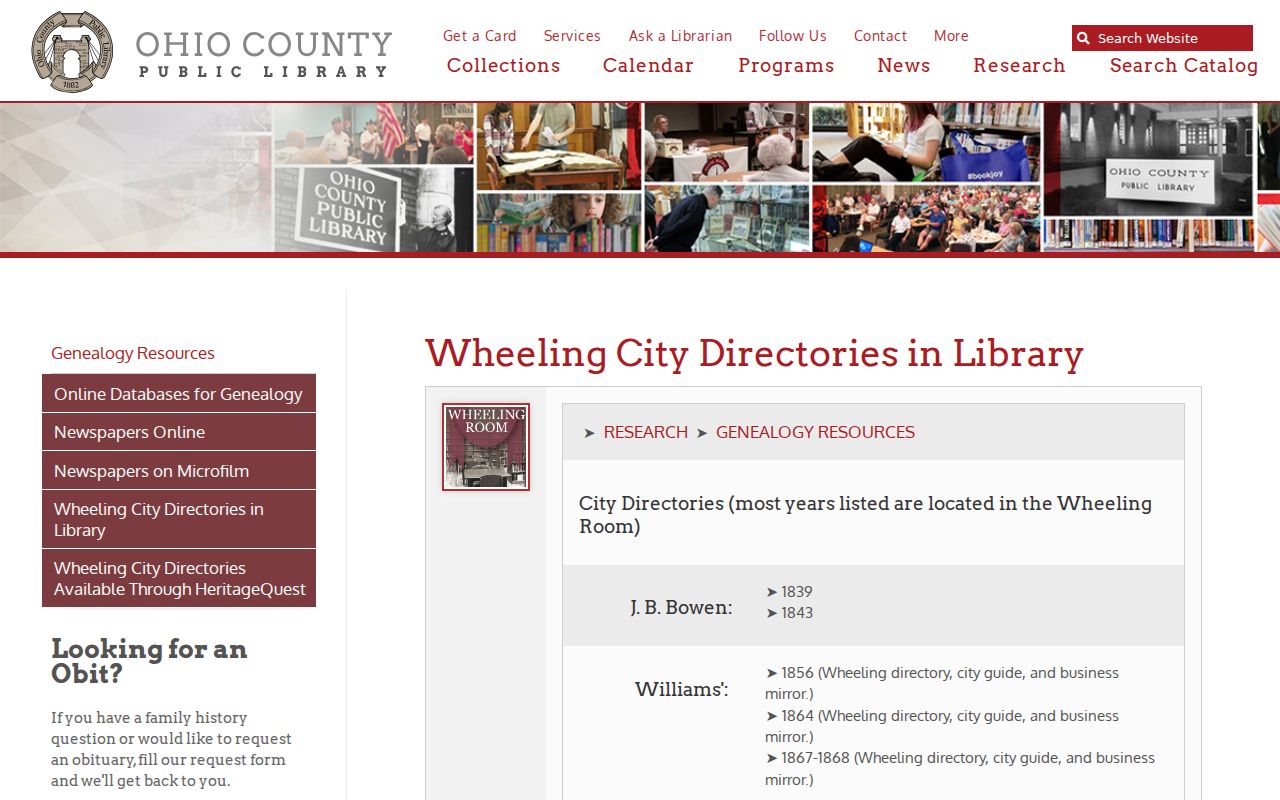
The captured inventory makes irregular gaps and paired-year editions visible before a library visit.
Wheeling Directories Beyond the Shelf
HeritageQuest through OCPL supplies remote access. Outside the library, users need a library card and login. Its interface supports title and page navigation, an index, A-Z browsing, reverse street access, and business navigation. The exact digitized years are kept in a linked spreadsheet, so do not assume every physical volume is online.
The OCPL digitized collections add more than 3,000 Flickr images, maps, newspapers, digital vertical files, the Wheeling Memory Project, Veterans project, and Archiving Wheeling. These sources can connect a printed name with a school, street, group, or public event without guessing at a current address.
Note: Remote access is useful, but the physical Wheeling Room remains essential when a listed volume or map is absent online.
Decode a Wheeling Directory Entry
Read the title page and abbreviation key before copying an entry. The 1839 description confirms fields for the person or head of family, trade, residence, and place of business. Later conventions may add a spouse, widow status, an occupation or employer, and distinctions between home and business addresses. Exact punctuation and shorthand vary by book, so preserve the printed wording.
| Name | Person or head of family; later entries may identify a spouse |
|---|---|
| Trade | Occupation and sometimes employer or business place |
| Residence | Printed street or alley and house number for that edition |
| Status mark | Possible owner, renter, widow, or residence distinction |
| Business place | A separate shop or work address when supplied |
- Criss-cross directory
- The reverse section that sorts streets and numbers, linking an address to a listed occupant or business.
- Householder index
- An address-oriented list of people responsible for or associated with a household, as that edition defines it.
- Abbreviation key
- The book's legend for shortened trades, status, street, and residence terms. Copy it before interpreting entries.
An entry shows a printed association, not proof of title or current presence. Compare neighboring editions, then check an assessor card or deed when ownership matters. For modern address records, use the Wheeling street directory workflow.
Wheeling Streets After 1898
Most directories from 1898 include a reverse street directory. Streets appear alphabetically, followed by addresses in number order and the occupants or businesses listed there. This is valuable when a surname is unknown, a store changed names, or several households shared a block.
Wheeling adds a major trap. Street names and numbers changed on July 11, 1873, and even a street that kept its name could receive new numbers. The library has a handout mapping pre-change and post-change forms. Preserve both versions before deciding that two entries refer to different places.
OCPL's historic-property guide explains the directory-first method and renumbering warning.
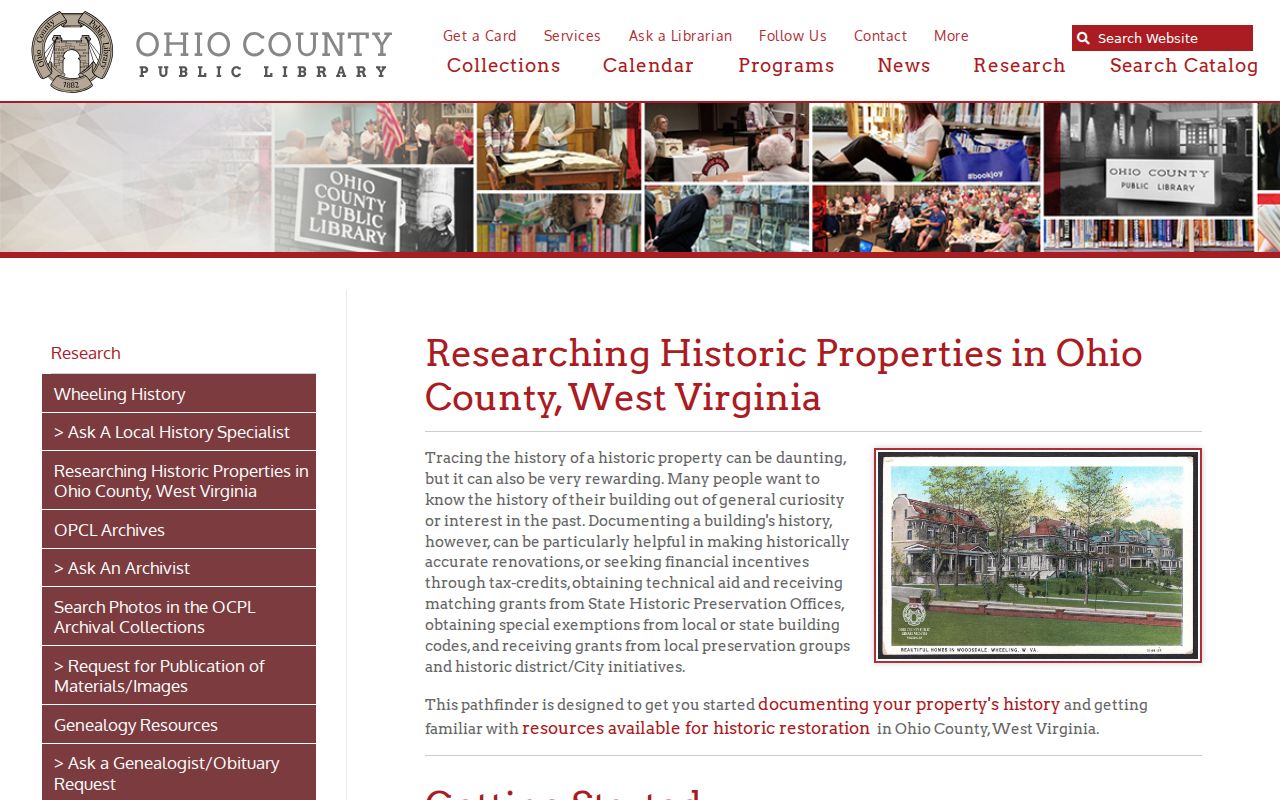
The guide supplies the old-address bridge that a modern parcel search cannot give by itself.
Map Wheeling Directory Addresses
OCPL's archives hold building-level maps from 1853, 1871, 1901, 1913, and 1918, often by appointment. Sanborn maps cover 1884, 1890, 1902, 1921-22, later updates through 1951, and 1952 across library and Library of Congress access. They show footprints and uses, not occupants.
The 1901 Wheeling atlas maps property owners with rail, streetcar, gas, water, and sewer context. A grayscale copy is online, while color viewing requires an appointment. The 1911 Polk map is digitized and tied to the 1911-12 directory.
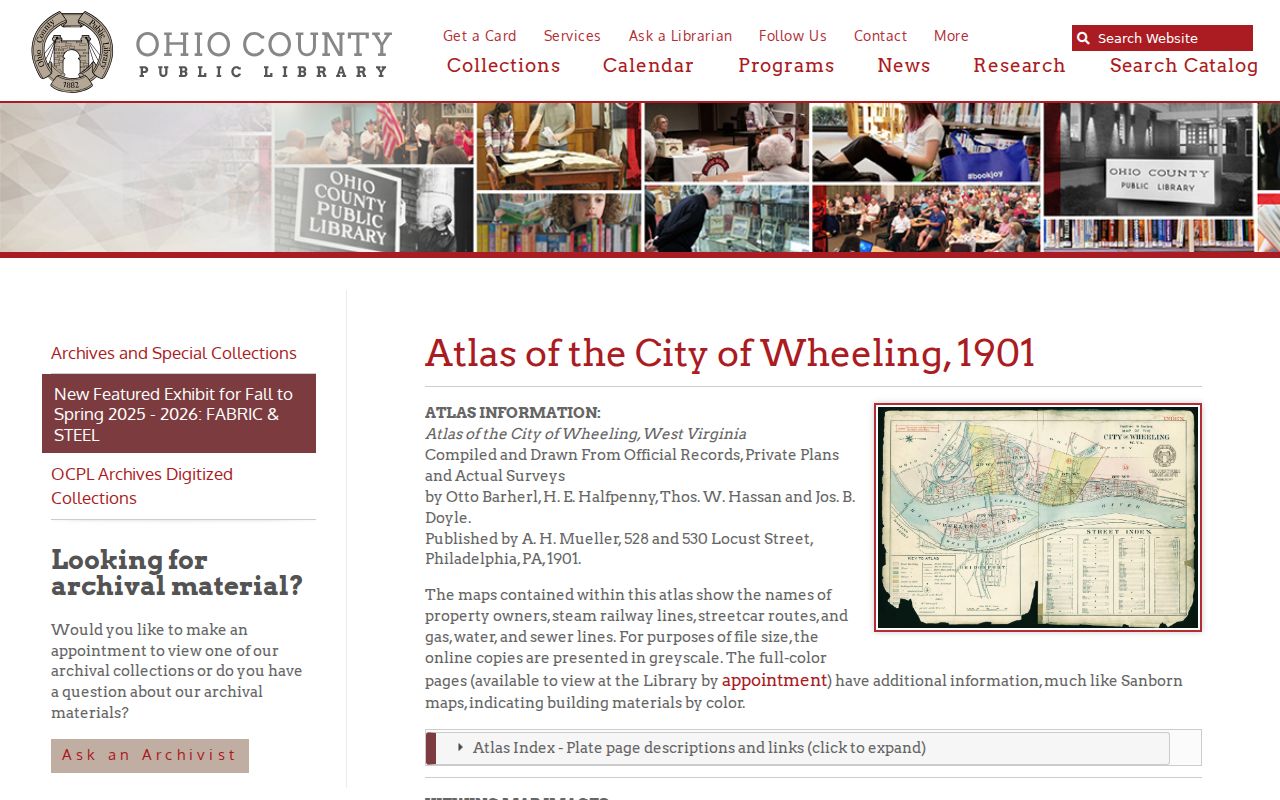
The atlas bridges a printed resident entry and the physical setting of the block.
Newspapers explain changes the books only record. OCPL offers online and microfilm access to the Intelligencer and News-Register, though its pages state different News-Register ranges. Four microfilm readers are available. Black-and-white copies cost 10 cents per page. Search obituaries, notices, advertisements, and civic news near the year a name appears or vanishes.
Wheeling Archives Add Context
The OCPL finding aids include Wheeling Area Historical Society records. The group formed in 1961 and disbanded in 2010. Other archives preserve photos, scrapbooks, personal and corporate papers, journals, letters, maps, pamphlets, and ads. Many items require an appointment and are arranged by creator rather than resident name.
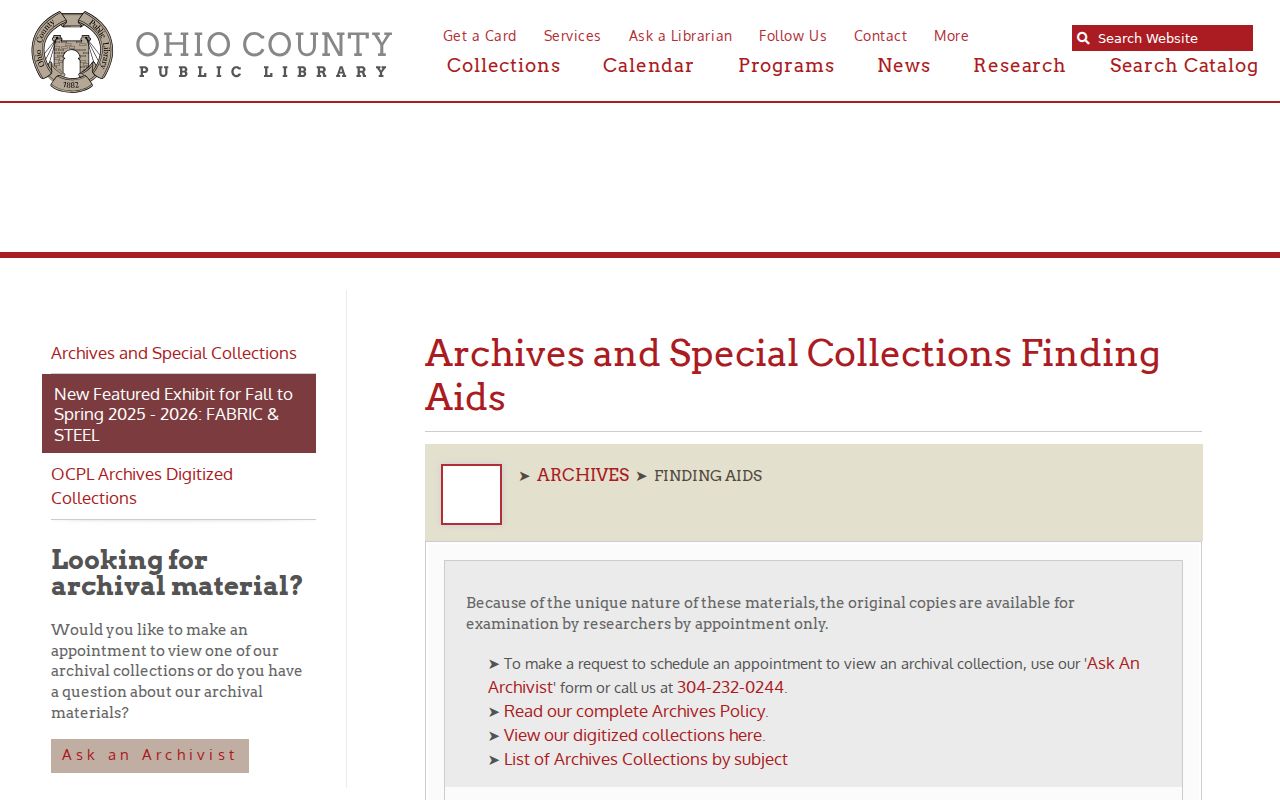
The finding-aid screen helps move from a city directory name to the creator or group behind a related archive.
The WVU Regional History Center adds microfilm identified by OHI number: deeds from 1777-1801, marriages from 1790-1827, an 1888 Wheeling ward census, and selected personal-property books from 1895-1903. Cite those identifiers in an archive request.
Trace Families Through Wheeling Directories
Build a family timeline one edition at a time. A single city directory entry can be unclear when initials repeat or a household moves within one street. Federal census schedules through 1950 can add household structure, while newspapers, cemetery indexes, probate files, and marriage records may explain a change.
- Find the first alphabetical entry and copy its spelling, status marks, trade, and address.
- Check nearby editions. Record moves and treat paired-year books as one observation.
- For 1898 and later, use the reverse section to inspect nearby numbers for relatives or linked businesses.
- Pair directory years with released census schedules, allowing for different wards and boundaries.
- Use newspapers, probate, cemetery indexes, and deeds to explain the end of a run or surname change.
Absence proves little. A person may have moved, died, married under another surname, been omitted, or lived beyond the publisher's range. Search initials and variants, then compare the address side. If a directory names an occupant and a deed names another owner, keep both facts. They answer different questions.
A strong research log lists the edition, page, exact entry, search spelling, and source format. It also notes which nearby years were checked with no result. This prevents a later researcher from treating silence as proof. When a census name differs from the directory spelling, retain both versions and look for the same trade, spouse, street, or business place. The Ohio County Clerk's probate and marriage files can then test a family link, while cemetery indexes and local obituaries may supply the dates needed to separate two people with similar initials.